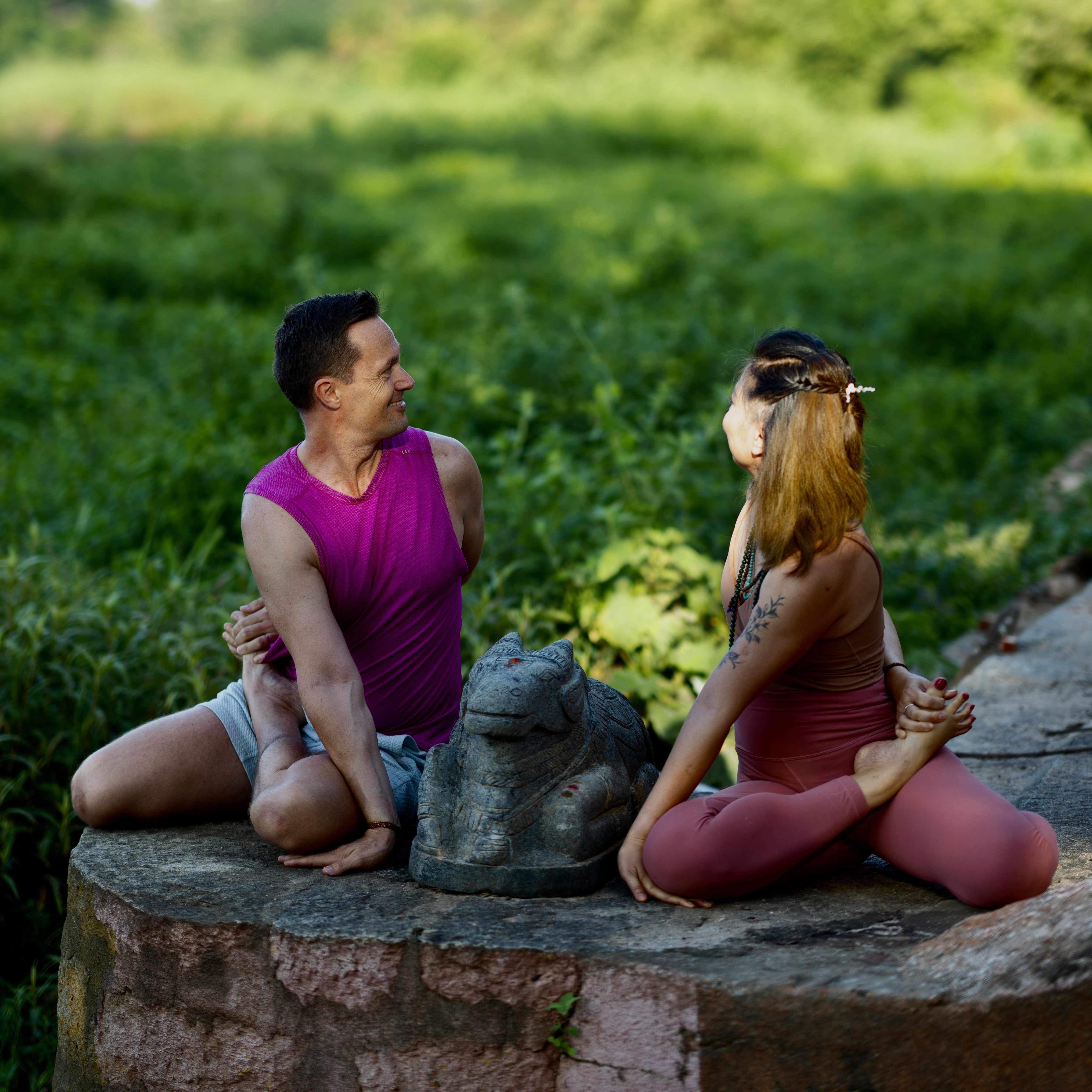
Ashtanga Yoga: The Primary Series, out 28 November

An Ashtanga Yoga Book for Building a Daily Practice That Lasts

Asbjรธrn and I have spent a long time putting the Primary Series into words. The book walks through the sequence pose by pose and looks at why it is built the way it is, so you can keep coming back to the mat and make the practice your own. It is book 2 in our A path within series, and the Kindle edition is available to pre-order now.

Every pre-order helps the book reach more practitioners, so thank you if you order early.

Non-Attachment Is Not Letting Go of the Student

By Huong (Claire) Luu (Bjaanes)

Key takeaways

  • Vairagya (non-attachment, Yoga Sutra 1.15) means letting go of the outcome, not letting go of care for the student.
  • Reaching out to a drifting student is right action; whether she returns is the fruit (Bhagavad Gita 2.47).
  • Studios keep roughly 40โ€“50% of members a year; a 5% rise in retention can lift profits 25โ€“95%.
  • Students speak up when they have a pre-class check-in, a private note to the teacher, and a link to their own goals.

Patanjali gives us two wings for practice: abhyasa and vairagya, steady effort and non-attachment (Yoga Sutra 1.12). Those of us who teach yoga have lived with both for years. We practise them on the mat and we pass them on in every class.

However, many of us carry a quiet misreading of the second wing, and it is costing our studios more than we see.

The empty mat spot

You know the scene. A student who came every Tuesday is gone for one week, then two. Her corner of the room stays empty. You notice, and you think about writing to her.

Then a voice says: “Let her go. Reaching out would be attachment, or worse, selling.”

So you stay silent, as most of us do. We became teachers to share practice, not to chase people. In our world, yoga should feel free, and a follow-up message can feel like a sales call.

The marketing treadmill

Meanwhile, the studio keeps paying. Rent, software, campaigns and teachers’ fees do not pause when students drift away. Fitness and boutique studios keep roughly 40โ€“50% of members by the end of the year, so a large share must be replaced, every year.

Therefore many studio owners live on a treadmill. New ads, new intro offers, new campaigns, all to refill a bucket with a hole in it. Research by Frederick Reichheld at Bain & Company found that a 5% rise in retention can lift profits by 25 to 95%. Keeping a student is almost always cheaper than finding a new one.

What vairagya really asks

Patanjali defines vairagya as freedom from craving for what we have seen or heard (Yoga Sutra 1.15). It is freedom from grasping, but it is not freedom from care.

The Bhagavad Gita (2.47) draws the line even more clearly: we have a right to our action, but not to its fruits. Reaching out is that action. Whether the student returns is the fruit, and that was never ours to grasp in the first place.

Seen this way, a short message to a drifting student is not a sales move. It is a teacher doing what teachers do best: noticing. We notice the breath that shortens, the shoulders that tighten. Noticing a student’s absence is the same skill, off the mat.

The silence on both sides

Students are no different. Few will tell a teacher that a class felt too hard, that their back hurts, or that they feel lost in a class.

So the teacher is silent, and the student is silent. The system gives neither of them a way to speak in time.

It is not a courage problem. A student needs three things to open up:

  1. A way to speak before class. A short check-in on how the body feels today: sleep, energy, pain, injury. The teacher can then adjust the practice before the class.
  2. A safe place to speak after class. A private note that goes only to the teacher, not to the whole room or a public review.
  3. A link to her own goals. Why she came to yoga in the first place: a calmer mind, a stronger back, a steady home practice. When the teacher knows the goal, each class can move her toward it, and she can see her own progress.

When these three are in place, silence turns into signal. The teacher hears the student in time. The student feels seen, heard and known. That is the missing feedback loop, from both sides.

The problem is not our values. It is our view.

The signs of a drifting student are there, but they are scattered: a gap in the booking system, a message in a chat thread, a feeling in the teacher’s head after class. No one sees the whole picture until it is too late.

At The Yoga Nest in Stavanger, we brought those signals together in one place, so teachers could see who was drifting while there was still time to act. In the first month, 3 students flagged as drifting came back.

What changes when we see

  1. Teachers act earlier, while a student is drifting, not after she is gone.
  2. Messages carry care, not offers. The teacher’s voice stays the teacher’s own.
  3. Studios step off the treadmill, because they lose fewer students.

Retention, done this way, is practice. It is abhyasa, steady effort, and vairagya, letting go of the result, working together, just as Patanjali taught.

Your next step

This week, write down every student you have not seen in two weeks. Choose one. Send a short message with no offer in it, only care. Then let go of the outcome.

Keeping is not selling. It is seeing.

May every student feel seen, heard and known, and may every teacher have the clarity to notice in time.


This article was first published on Conscious Flow.

Yoga Foundation Course: Two Days to Build Your Practice On

Beginner Yoga Workshop in Stavanger

Saturday October 24th and Sunday October 25th, Stavanger

Walk into class knowing what your body is doing, and why

Picture stepping onto your mat and feeling at home. You know where your breath goes, how your feet want to land, and what the teacher’s cue means for your body. Class stops being something you keep up with and becomes something you enjoy.

This weekend is your ramp up. Two days to build a solid base under everything you practice next.

Booking through Conscious Flow App https://theyoganest.no/yoga-app/

A foundation you can build on

Yoga is easier to love when the basics feel familiar. Over two days, you get the building blocks that make every class richer, whether you’re stepping onto a mat for the first time or you’ve been showing up for a while and want more from each session.

You’ll explore yoga through the Ashtanga lens, a clear and time-tested system that gives your practice structure, rhythm and direction. Even if you go on to try other styles, the foundation stays with you.

What you’ll explore

Day 1: Arrive, breathe and get grounded

  • Breath that steadies your body and calms your mind, and how it guides every movement
  • Your stance: how to stand, balance and build strength from the ground up
  • Sun Salutations broken down step by step, so the flow makes sense in your body
  • Gaze and focus, the quiet skill that helps your attention settle

Day 2: Build, connect and take it home

  • Standing postures with alignment you can feel, so they work for your body
  • Moving and breathing together, and how that turns a set of poses into a practice
  • Closing and rest, and why the last part of practice matters as much as the first
  • Your own rhythm: how to practice at home, how to choose classes that suit you, and how to keep growing at your pace

The paradigm that makes it click

Alongside the poses, you’ll get a way of looking at practice. Posture, breath and gaze work together. Small, steady steps lead to lasting change. Your body sets the pace, and you get to choose how deep you go.

This way of seeing your practice is what makes each class more meaningful. You’ll leave with tools you can carry into any room, any teacher and any season of life.

Who can join

This weekend is a great fit if you:

  • Are brand new to yoga and want a gentle, clear start
  • Have tried a few classes and would like things to make more sense
  • Practice already and want a refresher on the fundamentals
  • Are curious about Ashtanga and want to know how it works before diving in
  • Would like more confidence in class, in your body and in your own practice

Come as you are. Every body is welcome, and there’s no such thing as too stiff, too new or too late to begin.

What you’ll leave with

  • A clear understanding of breath, alignment and movement
  • A short, doable sequence you can practice at home
  • More ease and confidence in group classes
  • A framework you can grow into, at your own pace
  • The pleasure of knowing what you’re doing on your mat

Practical details

  • Dates: Saturday October 24th and Sunday October 25th
  • Time: 13:00 -15:30
  • Place: The Yoga Nest, Kirkegata 32, Stavanger
  • Price: 1199
  • Spots: Limited, so everyone gets personal attention and space to ask questions
  • Bring: A mat (or borrow one from the studio), comfortable clothes and your curiosity

Give yourself a strong start

Two days can shape the way you practice for years. Take your place, bring a friend, and start building something that grows with you.

Price: Kr 1199

Booking through Conscious Flow App https://theyoganest.no/yoga-app/

Open Your Hips, Open Your Practice – Workshop in Stavanger Oct 31

An exclusive Ashtanga hip opening workshop in Stavanger

An exclusive Ashtanga hip opening workshop

Imagine sitting into Padmasana without negotiating with your knees, or folding into Kurmasana with room to spare. Imagine your legs finding their way behind your head and your breath staying soft while they do. This workshop is a focused journey into the hips, drawing on the Ashtanga Intermediate Series, Nadi Shodhana, the “nerve cleansing” sequence.

Your hips hold much of your practice: the freedom in your seated postures, the ease in your twists, the lift in your arm balances. When they open, everything else follows.

What you’ll explore

๐Ÿ”น Hip Opening Foundations: Discover how your hips, pelvis and lower back work together, so you can approach deep postures with clarity and confidence.

๐Ÿ”น Leg-Behind-the-Head Postures: Enjoy a step-by-step path into Eka Pada Sirsasana and Dwi Pada Sirsasana, building mobility while your breath and focus stay steady.

๐Ÿ”น Deep Rest in Yoga Nidrasana: Experience the balance of surrender and strength in one of the most grounding shapes in the series.

๐Ÿ”น Firefly Pose Variations: Follow the path through Tittibhasana A, B, C and D, where open hips meet core strength and arm balance control.

What to expect

โœ… Guided drills and variations, so every posture meets you exactly where you are today.

โœ… Clear alignment insights that help you protect your knees and feel your hips do the work.

โœ… Simple strategies you can take home and weave into your daily practice.

โœ… A look at the energetic and philosophical side of the Intermediate Series, for a practice that reaches beyond the physical.

Your invitation

Whether you’re refining familiar postures or exploring new territory, you’re welcome here. This is a supportive space to explore at your own pace, ask questions and leave with more freedom in your body and more trust in your practice.

Your hips are ready when you are. Reserve your place and step into a practice that feels open, steady and yours.

Price: Kr 600,-

Booking through Conscious Flow App https://theyoganest.no/yoga-app/

Feel Steady and Light Upside Down: The 7 Headstands of Ashtanga, Sunday 1 November

The seven headstands (Sirsasana variations) arrive towards the end of the Intermediate Series, and each one asks something a little different of you. Three keep your hands free (Mukta Hasta Sirsasana A, B and C)

Sunday 1 November, 13:00 to 15:30 | The Yoga Nest, Kirkegata 32, Stavanger

Picture yourself upside down, breathing slowly and evenly, feeling completely at home on your head. Steady. Light. Calm.

This afternoon is about helping you get there. Over two and a half hours, you explore the seven headstands of the Ashtanga Intermediate Series, one variation at a time, at a pace that suits your body and your practice.

What you explore

The seven headstands (Sirsasana variations) arrive towards the end of the Intermediate Series, and each one asks something a little different of you. Three keep your hands free (Mukta Hasta Sirsasana A, B and C) and four keep your hands bound (Baddha Hasta Sirsasana A, B, C and D). Together they refine your balance, your focus and your sense of control, and they invite a quiet steadiness that carries into the rest of your practice.

During the afternoon, you get to:

  • Discover how your hands, forearms and shoulders create a stable base, so your neck stays light and free
  • Feel how breath and bandhas lift you up, so the pose comes from lightness rather than effort
  • Explore preparations and steps you can bring straight back to your own mat or your Mysore practice
  • Meet any hesitation about going upside down with personal guidance and plenty of space to try
  • Leave knowing which variation is your next step, and how you can approach it

Is this for you?

Perhaps you are just beginning to explore the Intermediate Series. Perhaps you already practise these headstands and would love to refine them. Either way, you are welcome, and the afternoon meets you exactly where you are.

Practical details

  • Date: Sunday 1 November 2026
  • Time: 13:00 to 15:30
  • Place: The Yoga Nest, Kirkegata 32, Stavanger
  • Price: 600 NOK
  • Language: English
1793534400

  days

  hours  minutes  seconds

until

your headstand afternoon

Save your spot in the Conscious Flow app.

Breathe Deeper, Practise Lighter: Traditional Pranayama, Saturday 7 November

Person practising seated pranayama breathing at a pranayama workshop in Stavanger

Saturday 7 November, 13:30 to 15:00 | The Yoga Nest, Kirkegata 32, Stavanger

Picture yourself sitting tall, your breath long and smooth, your mind quiet enough to hear it. Each inhale fills you with energy. Each exhale lets something go. This afternoon is an invitation to discover what your breath can do for you, on the mat and far beyond it.

In Ashtanga, the breath is the thread that holds your practice together. Every movement rides on it. When you refine your breath, your asanas often follow: your postures soften, your transitions lighten and the bandhas become easier to feel. Many practitioners discover that pranayama is the missing piece they didn’t know they were looking for. This pranayama workshop in Stavanger pairs naturally with Sunday’s marma and acupressure workshop, and everything you learn carries straight into your Ashtanga yoga practice.

What you’ll explore

  • The foundations of breath: Get to know the natural rhythm of your breath and how your diaphragm, ribs and belly move together, so every breath feels fuller and easier.
  • Ujjayi, refined: Revisit the breath you already use in every practice and discover how small changes in sound and length can steady your mind and warm your body.
  • Traditional pranayama techniques: Explore classic practices such as Nadi Shodhana (alternate nostril breathing), Kapalabhati and gentle breath retention, each introduced step by step at a pace that feels right for you.
  • Breath and bandhas: Feel how Mula Bandha and Uddiyana Bandha support your breath, and how that connection carries straight into your asana practice.

What to expect

  • A calm, guided session with clear instructions and time to experience each technique for yourself.
  • Simple sequences you can take home and practise in five to fifteen minutes a day.
  • Insight into how pranayama fits within the eight limbs of yoga, bridging your body and your mind.
  • Space to ask questions and explore how your own breath responds.

Who it’s for

Whether you’ve practised for years or are simply curious about breath work, you’re welcome here. Each technique comes with gentler options, so you can choose what feels right for your body on the day. If you’re pregnant or have a heart or blood pressure condition, let your teacher know at the start and you’ll receive adapted variations.

Your invitation

Your breath is with you every moment of every day. This afternoon, you get to meet it properly. Come as you are, settle in, and discover how a few quiet minutes of breathing can change the way you practise and the way you meet your day.

  • Time: Saturday 7 November, 13:30 to 15:00
  • Place: The Yoga Nest, Kirkegata 32, Stavanger
  • Price: 600 NOK, or 400 NOK with a monthly or annual subscription
  • Booking: through the Conscious Flow App

Touch the Points That Set You Free: Marma and Acupressure, Sunday 8 November

Person applying acupressure to marma points at a marma and acupressure workshop in Stavanger

Sunday 8 November, 13:30 to 15:00 | The Yoga Nest, Kirkegata 32, Stavanger

Imagine knowing exactly where to press when your shoulders feel tight after a long day, or how to settle your mind before sleep with nothing more than your own hands. Imagine bringing that same awareness to your mat, so tension melts away before your practice even begins.

Marma points are the vital energy points described in Ayurveda, the sister science of yoga. They sit where muscles, bones, joints and energy channels meet. Acupressure shares a similar wisdom: gentle, focused pressure on specific points can release tension, calm your nervous system and help energy flow more freely. Together they give you a simple and powerful way to care for yourself. This marma and acupressure workshop in Stavanger follows on beautifully from Saturday’s pranayama workshop, so you can enjoy the weekend as a whole or choose the day that suits you.

What you’ll explore

  • Marma foundations: Discover what marma points are, where the tradition comes from, and how these points connect your body, breath and mind.
  • Key points for practitioners: Locate points on your hands, feet, shoulders, neck and head that support everyday ease and a deeper practice.
  • Self-acupressure techniques: Learn how much pressure to use, how long to hold, and how to pair touch with your breath for the strongest effect.
  • Marma and your practice: Explore how these points relate to the areas you work with on the mat, from your hips to your spine to your shoulders, and how a few minutes of self-care can prepare your body to move.

What to expect

  • A hands-on, experiential afternoon where you practise on yourself.
  • Short sequences for morning energy, evening calm and recovery after practice.
  • Gentle breathing to deepen the effect of each touch.
  • A natural continuation of Saturday’s pranayama, while this session stands perfectly well on its own.

Who it’s for

This workshop welcomes everyone, whether you practise Ashtanga daily, teach yoga, or simply want practical ways to feel better in your body. No previous experience with Ayurveda or bodywork is expected. Wear comfortable clothes and bring your curiosity.

Your invitation

Your hands already hold the healing. This afternoon you discover where to place them. Come and leave with a self-care toolkit you can reach for anytime, anywhere, for the rest of your life.

  • Time: Sunday 8 November, 13:30 to 15:00
  • Place: The Yoga Nest, Kirkegata 32, Stavanger
  • Price: 600 NOK, or 400 NOK with a monthly or annual subscription
  • Booking: through the Conscious Flow App

Float Through Your Practice: Jump Back and Jump Through, Saturday 14 November

Person floating through a jump back at an Ashtanga jump back and jump through workshop in Stavanger

Saturday 14 November, 13:30 to 15:00 | The Yoga Nest, Kirkegata 32, Stavanger

Imagine your feet leaving the mat as you press into your hands, your body lifting and swinging softly through your arms to land seated, without a sound. Imagine jumping back into Chaturanga with the same ease, vinyasa after vinyasa, your breath leading the way.

The jump back and jump through are the threads that stitch the Ashtanga practice together. They appear dozens of times in every Primary Series, so each small improvement multiplies across your whole practice. When they start to flow, your practice feels lighter, more rhythmic and more joyful. And the secret is less about raw strength and more about technique, timing and a few key insights. This jump back and jump through workshop in Stavanger leads naturally into Sunday’s arm balance workshop, where the same lift and lightness carry you into flying postures.

What you’ll explore

  • The mechanics of lift: Discover how hand placement, shoulder engagement and a forward shift of weight create the space your legs move through.
  • Bandhas and core compression: Feel how Mula Bandha, Uddiyana Bandha and active core work make you lighter in your hands, so you lift from your centre rather than pushing with your arms.
  • Lolasana and other key drills: Practise focused drills that build the specific strength and body awareness these transitions call for, step by step.
  • Jumping through and back: Put the pieces together, exploring crossed-leg and straight-leg variations, and find the version that suits your body today.

What to expect

  • Clear progressions that break each transition into manageable stages.
  • Blocks and props to help you feel the lift long before you fly.
  • Personal pointers on the one or two changes that make the biggest difference for you.
  • A set of drills you can take home and weave into your daily practice, so progress keeps coming after the workshop ends.

Who it’s for

Whether you’re just beginning to explore jumping or already float some of the way, you’re welcome here. This afternoon is designed for all levels, and every drill comes with options, so you can work at your own pace toward your own goals.

Your invitation

Lightness is a skill, and you can learn it. Come and play, laugh at the wobbles and discover how close you already are to floating through your practice.

  • Time: Saturday 14 November, 13:30 to 15:00
  • Place: The Yoga Nest, Kirkegata 32, Stavanger
  • Price: 600 NOK, or 400 NOK with a monthly or annual subscription
  • Booking: through the Conscious Flow App

Up ↑