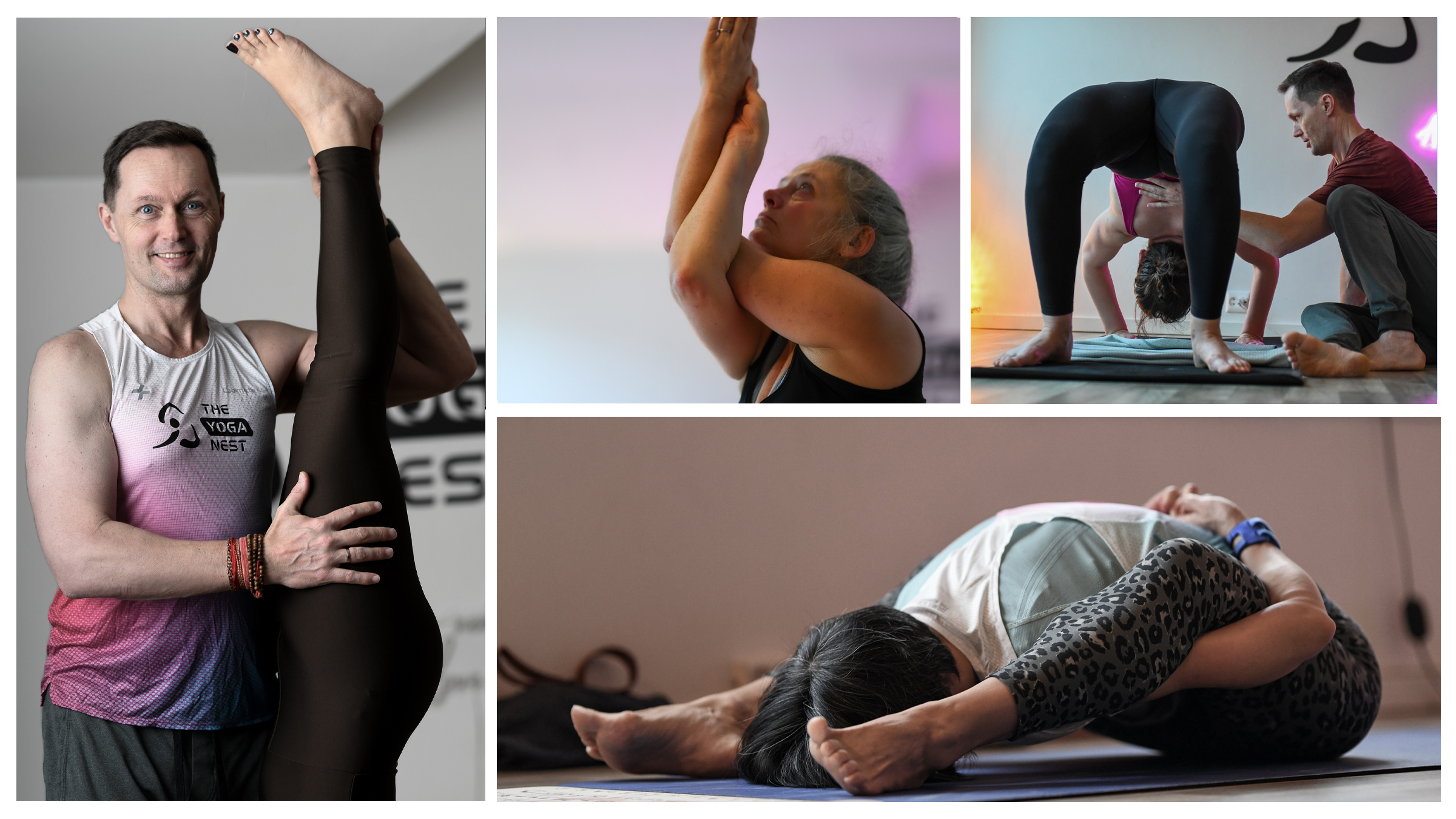
Step onto your mat and let an experienced teacher guide you through the traditional Ashtanga Vinyasa sequence, breath by breath, movement by movement.
You’ll flow through each posture with clear cues on alignment, so you can settle into the practice with confidence rather than guesswork. As your breath deepens, you may notice your mind quieting alongside it, that familiar Ashtanga clarity that carries you off the mat too.
Whether you’re new to the practice or have years of experience behind you, you can move at the pace that suits your body today. Come ready to build strength, open up flexibility, and leave feeling steadier in yourself.
Summer is calling you outward. Trips, long weekends, time away from the mat you know so well. And still, your practice can travel right there with you.
This summer, The Yoga Nest goes online, so you can bring your teachers, your community, and your rhythm wherever you land. Studio classes return on June 23rd, but until then, your practice stays exactly where it belongs: with you.
Wherever You Go, Your Teachers Go Too
Maybe you’re by the sea. Maybe you’re visiting family, working remotely, or simply enjoying a slower kind of summer at home. Wherever you are, you can still step onto your mat with the same teachers who know your practice, your edges, and your progress.
No pausing. No starting over in September. Just a continuous thread of transformation, held steady through the season.
An Online Experience Built to Feel Like Home
You deserve more than a video call and a hope for the best. That’s why we use Conscious Flow to bring you an online experience that mirrors the warmth, structure, and attention you feel in the studio.
You’ll have:
Live classes with your familiar teachers, guiding you in real time
The same care and correction you’ve come to expect, adapted thoughtfully for your space at home
A steady rhythm to keep your practice alive, wherever your summer takes you
A community that travels with you, even when you’re miles from the studio
Your Progress Is Yours to Keep
Every breath, every posture, every quiet moment of focus you’ve built this year belongs to you. Summer doesn’t have to interrupt that. It can simply become a new setting for the same devotion.
Choose to keep showing up. Choose to stay connected to your practice, your teachers, and yourself, no matter where the season takes you.
Join Us Online This Summer
Your mat is packable. Your practice is portable. And your community is right here, waiting for you online.
Your mat is calling, and booking your spot has never been easier.
All classes are now booked through the Conscious Flow AI App — and if you have not set it up yet, you are just a few minutes away from being ready for your next practice.
Your membership, punch pass and credits are already waiting for you in the app. Nothing to transfer, nothing to worry about.
Get started here Step-by-step instructions are right there on the page, so you can be booked into your next class before you even roll out your mat.
A Transformative Journey into Ashtanga Yoga | March – July 2026
Take the next step of self-discovery, deepen your connection to yoga, and step confidently into your true potential as a teacher or practitioner with our 200-hour Ashtanga Yoga Teacher Training. Whether you dream of mastering your practice, guiding others with confidence, or simply immersing yourself in the transformative power of yoga, this training is designed for you, this program combines self-paced learning, weekend workshops, Mysore integration, and an immersive 2-week intensive in Stavanger, Norway.
Why This Journey is Meant for You
✔️ Flexible Learning: Structured study, weekend workshops & guided Mysore practice ✔️ Personalized Training: Small-group adjustments & in-depth technique refinement ✔️ Expert Guidance: Learn from experienced teachers in a supportive environment ✔️ Yoga Alliance Certification: RYT-200 accredited training
Program Structure
📖 March – June 2026: Build Your Foundation & Ignite Your Passion
Foundations: Asana technique, breathwork, and applied anatomy
Philosophy & Pranayama: Yoga Sutras, Ayurveda, meditation, and breath mastery
Mysore Integration: Weekly guided Mysore practice to apply workshop learnings
🔥 July 2025: Your Immersive Yoga Transformation in Norway
12 week NLP course for Yoga, Fitness and Wellness Professionals starting March 1st
Yoga is a journey of self-awareness, transformation, and connection. As yoga teachers, we guide students through Yoga, fitness and wellness are journeys of self-awareness, transformation, and connection. As professionals, we guide clients and students through breath, movement, training, and mindfulness to help them cultivate balance in body and mind. But what if we could enhance this process by understanding the language of the mind itself? This is where Neuro-Linguistic Programming (NLP) becomes a powerful tool.
What if your words could guide a deeper change in your students, clients — and yourself?
What if your words were powerful enough to light that spark in those you work with… and deepen your own presence as a professional?
Join our 12-week NLP journey designed for yoga teachers, fitness coaches, instructors, and wellness professionals. You’ll discover how subtle shifts in language, pacing, and sensory attention can help you hold space with clarity, calm, and real connection.
NLP helps us understand how the human mind interprets and processes information, collecting input through the sensory system and running it through our internal maps of the world. This process involves filtering, adding missing information, and making meaning by filling in blanks. Understanding this allows us to refine our language, perceptions, and behavior to make communication more effective.
We process information primarily through three key sensory channels:
Visual Processing: How we interpret the world through sight, images, and spatial awareness.
Auditory Processing: How we process sounds, language, and verbal communication.
Kinesthetic Processing: How we perceive and understand through touch, movement, and sensation.
Beyond these sensory modalities, NLP also considers meta models and meta programs, which act as unconscious filters shaping how we interpret experiences. These filters, unique to each individual, influence thought patterns, decision-making, and emotional responses. By understanding these differences, we can refine communication, enhance learning, and help shift perspectives more effectively.
Imagine how two people can experience the same situation but interpret it completely differently. Why does one person see a challenge as an opportunity while another feels stuck? NLP provides insight into these differences and offers strategies to shift perspectives toward growth and empowerment.
Guiding others goes beyond delivering sequences, workouts, or techniques; it’s about creating an experience that supports growth, awareness, and transformation. Whether you teach yoga, coach fitness, or work in wellness, NLP offers tools that deepen this process.
The Power of Language
Different words trigger different thought processes. In a meditation class, personal training session, or group fitness setting, the language you choose influences how information is received and processed. If new instructions are given before someone has completed processing the previous ones, it can create cognitive overload rather than clarity. By understanding how language influences thought patterns, you can allow space for words to settle, ensuring your cues guide rather than overwhelm.
Words shape perception. How you phrase cues, offer encouragement, and structure instructions can significantly impact a client’s experience. NLP helps refine communication so that language supports clarity, confidence, and empowerment.
Understanding Learning Styles
Every person processes information differently. NLP identifies three primary learning modalities:
Visual Learners respond best to imagery and demonstrations.
Auditory Learners thrive with clear verbal instructions.
Kinesthetic Learners connect deeply through physical experience and sensation.
By incorporating all three styles into your teaching or coaching, you create a more inclusive and effective learning environment.
Building Rapport and Connection
Connection is the foundation of effective guidance. NLP techniques like mirroring body language, pacing breath patterns, and active listening can help establish trust and strengthen the professional-client relationship.
Shifting Limiting Beliefs
Many clients (and professionals) carry unconscious beliefs that limit progress – “I’m not flexible enough,” “I’ll never get stronger,” or “I’m not good at this.” NLP provides tools to recognize and reframe these limiting thoughts, supporting a growth-oriented mindset in and beyond the training space.
Anchoring Positive States
NLP teaches how to create “anchors”—associations that trigger specific emotional states. In a class or coaching session, this might involve using a particular breath technique, cue, movement pattern, or focus point to help clients access calm, confidence, or concentration when they need it.
Integrating NLP into Your Teaching or Coaching
A professional with NLP skills can enhance their ability to guide others by adapting communication to learning modalities, building rapport, and fostering confidence—both in themselves and in those they work with.
Adapting Communication to Learning Modalities: By recognizing whether someone responds primarily to visual, auditory, or kinesthetic input, you can tailor instructions more effectively. Using imagery for visual learners, clear structured cues for auditory learners, and experiential guidance for kinesthetic learners increases engagement and understanding.
Building Rapport: Techniques such as mirroring posture, matching breathing rhythms, and active listening help create trust and openness.
Enhancing Client Confidence: By applying strategies like reframing negative thoughts and reinforcing progress, you support a shift from “I can’t do this” to “I am improving step by step.”
Developing Confidence as a Professional: NLP also strengthens your ability to communicate clearly, navigate group dynamics, and respond to different personalities with composure and presence.
Bringing NLP into your sessions doesn’t require a complete overhaul. It begins with subtle shifts in how you communicate, observe, and guide:
Use Empowering Language: Replace restrictive phrasing with supportive direction.
Observe and Adapt: Notice how individuals respond to verbal cues, demonstrations, or experiential guidance.
Encourage Positive Mindset Shifts: Support curiosity and self-compassion over self-criticism.
Create Emotional Anchors: Introduce techniques that clients can access beyond the class or session.
The Path Forward
Integrating NLP is about refining how you create space for transformation. As you apply these principles, you may notice deeper connection, clearer communication, and greater confidence in your professional role.
Begin by observing how people respond to different communication styles. Experiment with pacing your instructions and allowing space for processing. Small adjustments can influence how experiences are perceived and integrated.
Whether you work with breath, movement, strength, rehabilitation, or mindset, NLP enhances your ability to support sustainable change – physically, mentally, and emotionally.
A collaboration designed to support safe practitioner progress and sustainable careers for yoga teachers worldwide.
The Yoga Nest and Conscious Flow today announced a strategic partnership aimed at strengthening the future of yoga communities by combining studio experience, teacher education, and technology-driven wellness solutions.
The collaboration brings together The Yoga Nest’s thriving yoga community in Stavanger and Conscious Flow’s emerging wellness technology platform focused on supporting practitioners and teachers globally. Together, the organizations aim to help practitioners progress safely while empowering teachers to build sustainable professional careers.
Through this partnership, both organizations will work to integrate practical studio experience with digital tools that help people practice smarter, improve wellbeing through awareness and prevention, and help teachers grow sustainable livelihoods doing what they love.
Conscious Flow, supported by Innovation Norway, focuses on helping individuals take ownership of their health while addressing systemic challenges in the yoga industry, where many teachers struggle with unstable income and lack of long-term professional support.
• SDG 3 — Good Health & Well-being • SDG 8 — Decent Work & Economic Growth
“This partnership allows us to bring together community, teaching experience, and technology to support both practitioners and teachers in a more sustainable way,” said Claire Huong Bjaanes Luu, co-founder of The Yoga Nest and Conscious Flow. “We believe yoga communities deserve tools and systems that help them thrive long term.”
The collaboration will support development of tools, programs, and educational initiatives that help yoga practitioners maintain safe and consistent practice while giving teachers opportunities to grow professionally in a rapidly evolving wellness landscape.
More initiatives and community programs resulting from this partnership will be announced throughout the year.
The Yoga Nest is a Stavanger-based yoga studio and community space offering Ashtanga and modern yoga programs, teacher training, and workshops designed to support long-term practice and community wellbeing.
Conscious Flow is a wellness technology initiative designed to help yoga practitioners progress safely while enabling teachers and studios to build sustainable careers and businesses through technology-enabled support systems.
Book No 1 in the series – Understanding the yoga sutra by Patanjali
Yoga for Modern Practitioners is an invitation into a deeper way of living. This book invited reader to use the practice in yoga and breathing as a way to cultivate mindful awareness in everyday life experience.
Written for those seeking more than physical postures, this book guides readers along the mindful path for self, where yoga becomes a lived experience rather than a technique to master. Through reflections on the Yoga Sūtra by Patanjali that written thousands years ago, mindful breathing yoga, and the subtle movements of the mind, the reader is gently led toward inner peace with clarity.
This is a self-guided mindfulness journey for modern practitioners who wish to understand the mind, soften mental fluctuations, and reconnect with what is already whole within. In this journey, your breath becomes an anchor, your awareness becomes a refuge and your practice becomes a doorway to transformation.
Blending classical yogic wisdom with modern language, the book supports an inner wellness journey that unfolds slowly through reflection, practice, and honest observation. This book not offers your a quick fix but an invitation to a mindful transformation path grounded in discipline, compassion, and lived experience.
Whether you are new to yoga philosophy or returning to it with fresh eyes, this book serves as a steady companion, one that reminds you that freedom is not something to achieve, but something to remember, breath by breath.
Every New Year begins the same way: new goals, fresh motivation, a sense that this year will be different. And yet, weeks or months later, many of us find ourselves right back where we started, and quietly ask, “What’s wrong with me?”
The truth is uncomfortable but freeing: most people don’t fail because they lack motivation. They fail because motivation is fragile, especially when motivation rests purely on strong will.
Why motivation alone doesn’t work
Motivation is emotional, spikes when things feel exciting and fades when life gets hard. And life always gets hard.
When stress rises, when energy drops, when doubt creeps in, we don’t rise to our goals, we fall back to our habits. That’s why so many people set powerful goals in January, push hard for a short period, and then quietly abandon them and feel defeated, not because they are weak but because they were relying on willpower instead of a system.
Goals are visible to us, but the system is not clear. For example, my goal is to lose weight, build a business, write a book, feel better, find balance and my system are my daily habits, routines, environment, feedback, support, and structure.
If there’s a gap between your goal and your system, the system always wins.
You will inevitably end up where your daily habits are carrying you.
Why the system always wins
Think about athletes wanting gold medals, every job applicant wants the role, every entrepreneur wants success. Every academic wants a PhD. The goal is the same.
What differs is preparation, consistency, coaching, recovery, feedback and structure.
We don’t rise to the level of our goals. We fall to the level of our systems. The outcome followed naturally.
Why people fail (and feel defeated)
People fail because:
Goals have endpoints: You either hit them or you don’t and then what?
Systems are missing or fragile: There’s no structure when motivation drops.
No feedback loop exists: People don’t know if they’re progressing or not.
Change is attempted alone: No coach. No guide. No reflection. No accountability.
Life interrupts: Stress, illness, work, family—without a system, everything collapses.
And then comes the worst part: people blame themselves.
What actually creates lasting change?
Lasting change comes from translation big visions into small daily habits, intention into repeatable action, effort into structure
For example: If you want to read 30 books a year, start with one page before bed. If you want to get fit, prepare your yoga outfit the night before, prepare your meal and kombucha the night before. You want to build a business, start with hiring systems, feedback loops, testing, not just revenue goals.
This is exactly why Conscious Flow exists.
Not to motivate you more. Not to give you bigger goals. Not to replace human wisdom with technology But to help you build and sustain a system that supports daily habits, offers reflection and feedback, connects you with real teachers, coaches, therapists, adapts when life gets hard, prevents breakdown before it happens
Because most people don’t need more inspiration. They need structure that holds them when inspiration fades.
Goals are useful but they are not enough.
Without a system, a goal is just a wish. Without support, discipline becomes fragile. And when you build the right system, with the right habits, the right structure, and the right human support, the results begin to take care of themselves.
That’s not failure-proof living, that’s sustainable change.